Incremental Game Meaning and How It Works
Some games thrive on doing very little. You tap a button, a number goes up, and an hour quietly slips away. These titles don't ask for fast reflexes or hours of tutorials. They pull you into a gentle rhythm of small wins, often running in a background tab while you do something else. Once seen as novelties, they now shape how we think about reward, attention, and play itself.
A Genre Built on Patience, Not Reflexes
The first thing you notice about an incremental game is how little it asks of you. There's no boss to fight, no opponent to outsmart in real time. You make a small choice, watch a number climb, and pick what to spend it on next. That gentleness is exactly why the format thrives across browsers, mobile stores, and casual entertainment hubs like royals tiger, where slow, steady engagement sits comfortably alongside more traditional gaming options.
What makes these games different from other casual titles is how they treat time. Most games pause when you leave. They reward focused play. Incremental games do the opposite. They keep ticking while you cook dinner or sit in a meeting. Coming back to a quietly grown empire of cookies, kittens, or paperclips becomes a small ritual. And the ritual is the hook.
What Actually Defines an Incremental Game
Ask five players for an incremental game definition and you'll get five different answers. At its core, the genre describes any game where the main mechanic is the slow build-up of a resource. You earn it by clicking, waiting, or automating. You then spend it on upgrades that speed things up. The incremental game meaning stretches further, though. It also covers idle games, prestige loops, and even strategy titles that borrow these ideas.
Core Characteristics
A few traits define what is an incremental game in practice:
- A central resource that grows through both active and passive play
- Upgrades that multiply or compound your rate of progress
- Numbers that scale into the millions, billions, and beyond
- A "prestige" reset that trades current progress for permanent bonuses
- Almost no failure states — you can rarely lose, only slow down
- Simple presentation, often just one screen with text and small visuals
- Long time horizons that reward returning over hours or days
These ingredients mix in countless ways. That flexibility is part of why the genre has aged so well.
| Mechanic | What It Does | Typical Player Experience |
|---|---|---|
| Active clicking | Generates resources on input | Engaging in short bursts |
| Idle generation | Produces resources passively | Encourages stepping away |
| Upgrades | Boosts production rates | Frequent small decisions |
| Prestige loops | Resets progress for bonuses | Long-term strategic depth |
From Capybara Clicker to Idle Empires: The Evolution of a Niche
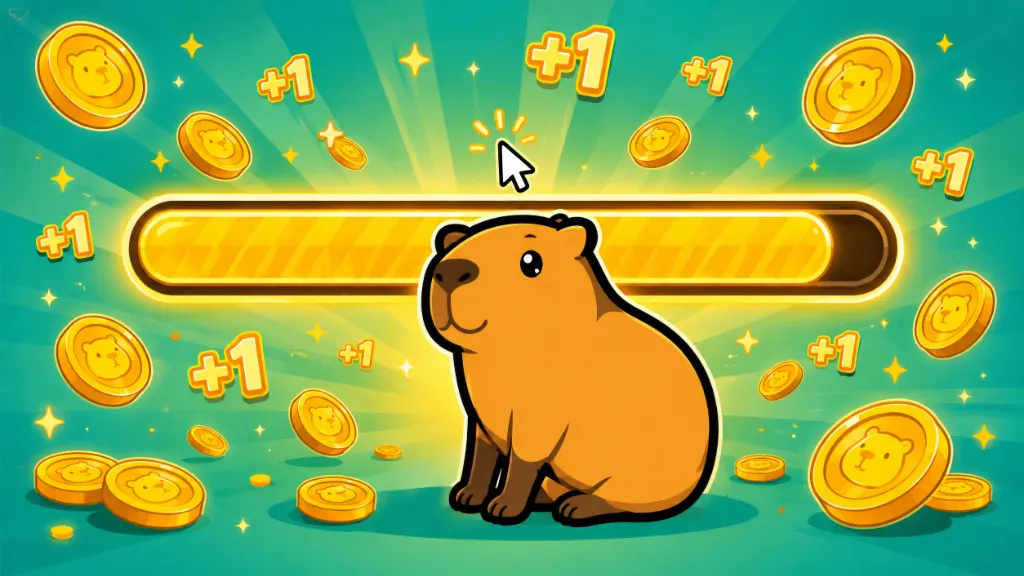
The genre has a clear history. Early text-based browser games tested passive progression in the 2000s. But the format truly clicked with Cookie Clicker in 2013. The game turned baking biscuits into a quiet obsession and proved that watching numbers grow could carry an entire experience.
"We didn't set out to invent a genre. We just made something we thought was funny, and people kept playing it for years." — Julien Thiennot, creator of Cookie Clicker
A wave of imitators and inventors followed. Capybara Clicker arrived as a charming modern descendant. It swapped pastries for the internet's favourite unbothered rodent and proved the formula still works in fresh packaging. Adventure Capitalist pushed the genre toward business simulation. Universal Paperclips, written by a journalist, used the form to tell a quietly unsettling story about artificial intelligence. Each title stretched what an incremental game could be.
| Title | Year | What It Brought to the Genre |
|---|---|---|
| Cookie Clicker | 2013 | Mainstream breakthrough and prestige loops |
| Adventure Capitalist | 2014 | Business simulation framing |
| Universal Paperclips | 2017 | Narrative depth and a defined ending |
| Capybara Clicker | 2022 | Modern presentation for a new audience |
Why Slow Progress Feels So Rewarding
The psychology behind these games is more interesting than they let on. Researchers have long shown that variable rewards and visible progress drive engagement. Incremental games deliver both in pure form. Every upgrade is a small promise kept. Every milestone marks real effort, even when that effort was mostly waiting.
There's also something modern about how these games fit into a fragmented day. They don't fight for your focus the way a cinematic adventure does. They sit at the edge of your attention and ask for a few seconds at a time. That's the kind of interaction many people can actually sustain.

"The genre succeeds because it externalizes a feeling we already chase — the sense that something, somewhere, is quietly improving because of us." — Adrian Hon, game designer and author of You've Been Played
Echoes of the Incremental Loop in Modern Digital Entertainment
The fingerprints of incremental design are now everywhere. Mobile RPGs use idle mechanics to keep players coming back. Productivity apps borrow progress bars and streaks. Even fitness platforms lean on the same psychology of small, visible gains. The genre's vocabulary — passive income, prestige, compounding upgrades — has become a shared language across digital culture.
Where the Influence Shows Up
You can spot incremental DNA in places that have nothing to do with cookies or capybaras:
- Mobile RPGs with offline rewards and auto-battle systems
- Language learning apps that gamify streaks and experience points
- Crypto and trading interfaces that visualize accumulating value
- Fitness trackers that reward consistency over intensity
- Subscription platforms that show library growth over time
This spread isn't accidental. Designers across industries have learned that meaningful engagement doesn't always need intensity. Sometimes it just needs a number that goes up, reliably and visibly.
The genre's quietest win may be its honesty. Incremental games never pretend to be more than they are. They offer a small, dependable loop of effort and reward, and they trust you to find meaning in it. In an entertainment landscape that often shouts for attention, there's something restful about a game content to whisper. Whether you're tapping a capybara or running a digital empire, the appeal is the same — progress, even modest progress, can be its own pleasure.